
Real inclusion: the essential for it to work
It's not that we disagree with inclusion. On the contrary.
There is a truth uncomfortable that it's becoming increasingly difficult for me to keep quiet... when I enter a classroom, when I listen to a family, when I talk to exhausted teachers:
This is not inclusion.
Because talking about TORCH in the classroom It's not about simply putting all the children in the same classroom and trusting that, just by being together, everything will work out. That's not inclusive education. That's physical presence without the real conditions for learning.
And when inclusion is reduced to that—to simply being present—what emerges is not coexistence, but stress. Stress for the child who doesn't understand what is expected of them. Stress for the teacher who tries to handle everything with empty hands. Stress for the group, who sense the tension and are affected by it.
_____________________________
The fundamental error: confusing “being” with “participating”
_____________________________
A school can say "we are inclusive" and yet be leaving a child completely out.
Because true inclusion isn't measured by whether a child is sitting in a chair in the classroom. It's measured by something much more uncomfortable: if that child can participate, learn, and belong.
Participating means understanding what's going on and having a way to get involved in the activity.
Learning means that the environment is adapted to make learning possible, not just desirable.
Belonging means not experiencing the classroom as a place of constant threat, but as a place where one can be safe.
When those three things are missing, what we're doing isn't inclusion. It's exposure.
_____________________________
What happens if we continue like this?
The child with special needs doesn't learn… and the system interprets it as “behavior”
_____________________________
When a child lacks support, it's not that they "don't want it." It's that cannot.
He cannot sustain attention because the environment overwhelms him.
He cannot follow instructions because the language we use is not adjusted to his level.
He cannot wait his turn because he does not understand the point of waiting.
It cannot be regulated because no one taught it what to do with its body when it is activated.
And then what the world calls "behavior" appears: shouting, running away, pushing, crying, opposition, tantrums, blocking.
But often that's not a behavioral problem. It's a problem of communication.
It's the body saying: "I don't understand," "it hurts," "this is too much," "I'm scared," "I need to stop.".
If the child does not have an alternative way to express that, the message comes out however it can.
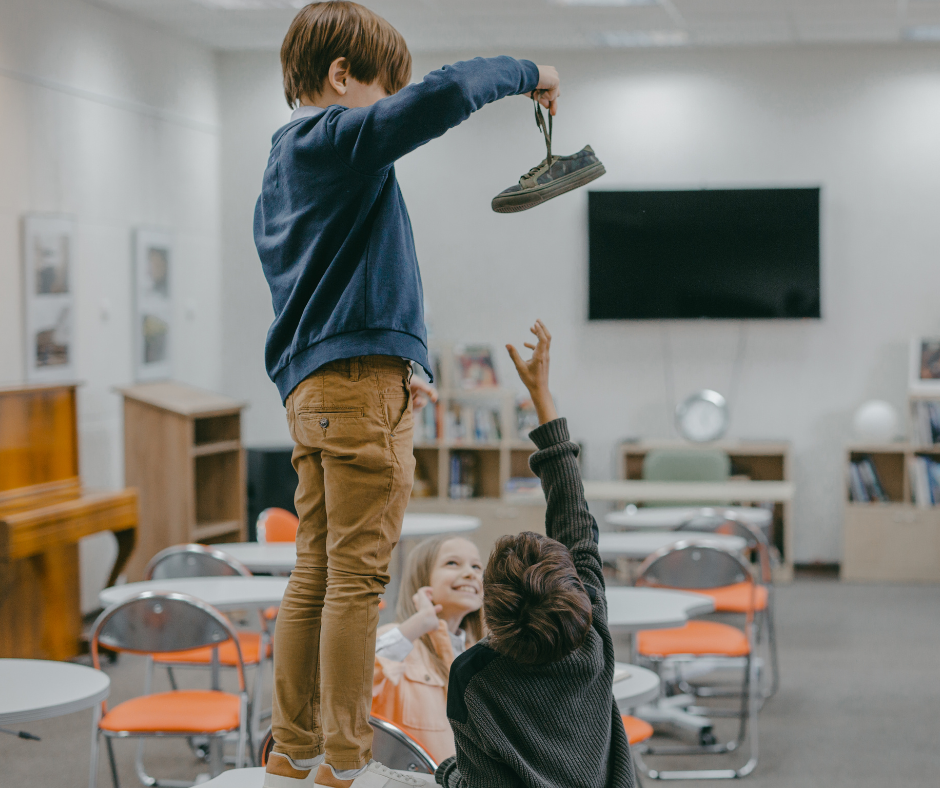
His teammates also lose (and a dangerous idea takes root)
When a classroom is overcrowded, the entire group suffers. Classmates don't just "observe" what's happening: they experience it.
They experience constant interruptions.
They are experiencing tension.
They live in fear if there are intense crises.
And, if no one accompanies and explains, some children begin to build a silent narrative: "this is unfair", "this takes from me", "this is a problem".
That is where diversity unfairly becomes an enemy.
And that's devastating, because inclusion should be the place where we learn to live with difference. But for that to happen, the classroom needs structure, support, and adult guidance. Otherwise, what grows is not empathy: it's rejection.
_____________________________
Teachers burn out because they are asked to do the impossible.
_____________________________
There is a part of this conversation that is often overshadowed by guilt and fear: teacher burnout.
The teacher is asked to teach, manage, contain, adapt, evaluate, attend to 25 or 30 children… and also sustain complex situations without specific training, without stable support and without real time to plan.
It's not a lack of vocation.
It's a system failure.
And when the system fails, the teacher's body pays the price. Anxiety. Insomnia. The feeling of always being late. Guilt for not being able to cope. And, in far too many cases, sick leave or leaving the profession altogether.
People who loved teaching end up hating their job. And that's not just sad: it's a huge social loss.
_____________________________
Families live in a state of constant alert and end up feeling guilty.
_____________________________
Calls from school become a routine:
“Come and get your son.”
“We can’t take it anymore.”
“Perhaps he needs a special center.”
And each call doesn't just disrupt family life. It also leaves an emotional message: "Your child doesn't fit in.".
Many mothers and fathers experience something very difficult: they begin to live with their phones in their hands. Afraid it will happen again. Ashamed. Guilt-ridden. Feeling like they are failing.
But no. They're not failing.
What's failing is a inclusion without resources, which is sold as a right but is executed as improvisation.
_____________________________
Real inclusion is something else entirely.
_____________________________
True inclusion is not an act of good intentions. It is a technical, human, and sustained effort.
And it begins with a simple question: What does this child need to be able to be okay here?
Not to "behave well." To be well.
_____________________________
True inclusion is functional communication
_____________________________
When a child can communicate, the classroom changes.
Not because he becomes "perfect", but because he stops being trapped.
A child who can say (with words, with gestures, with pictograms, with an augmentative system): “I need a break”, “I don’t understand”, “I want that”, “the noise bothers me”, “I’m hungry”, “it hurts”… is a child who no longer needs to scream with their body.
Functional communication is a form of prevention. It is a form of dignity. It is a form of safety.
And it is also a form of connection: because when the environment understands the child, the child feels seen.
_____________________________
True inclusion means preparing the environment (not demanding that the child adapt on their own).
_____________________________
There is an idea that does a lot of harm: "they'll adapt.".
No. Children don't adapt by magic. They adapt when the environment is predictable, when there are visual supports, when routines make sense, when transitions are anticipated, and when materials are appropriate.
Preparing the environment is not about "lowering the bar". It's about designing the access.
It is understanding that learning is not just content: it is regulation, attention, motivation, security.
_____________________________
Real inclusion means practical training for professionals
_____________________________
The kind of education that changes classrooms isn't the kind that fills notebooks. It's the kind that gets down to earth.
The one that teaches how to read early signs of dysregulation.
The one that provides concrete strategies for anticipating crises.
The one that shows how to teach communication, how to reinforce without overstimulating, how to structure an activity so that the child can participate.
And, above all, the one that accompanies the teacher without judgment. Because no one improves from guilt.
_____________________________
Real inclusion means resources and partnerships with families
_____________________________
Family is not "the problem." Family is part of the team.
When a family receives clear tools, when they understand what to do at home, how to maintain routines, how to strengthen communication, how to support without breaking down… the child progresses more.
And the school breathes too.
The inclusion Reality is built through alliances, not emergency calls.
_____________________________
When a child has the tools, they flourish (and everyone wins)
_____________________________
When a child feels understood and safe, something happens that often seems like a miracle, but it isn't: it's neurodevelopment.
Reduce stress.
Attention appears.
The imitation begins.
Improve interaction.
Learning becomes possible.
And then yes: the child wins, the group wins, the teacher wins, the family wins.
True inclusion is not romantic. It's demanding.
But it is also deeply hopeful, because when done right, it transforms lives.
_____________________________
If you want to talk
_____________________________
If you are in Spain and are experiencing this reality (as a family, teacher or school), and you would like us to look at it calmly and with professional judgment, You can write to me using the form. contact from my website.
Sometimes you don't need "more strength." You need structure, tools, and a realistic plan.
And that can be built.