

Therapy doesn't live in one hour a week: it lives in the day-to-day.
The language stimulation at home It is not sustained by willpower: it is sustained by simple, repeatable and realistic micro-routines.
____________________________________
The scene that repeats itself (and that no one explained to you)
____________________________________
There's a scene that repeats itself in countless families, and it almost always starts the same way: you leave therapy feeling hopeful. You've seen your child look, imitate, maybe even ask for "more" with a gesture or a word, and for a moment you feel like everything falls into place. You leave thinking: "Okay. Today we did it. Today we've succeeded." As if you'd been given a clear map... and with the shortest route, no less.
And then life arrives. Real life, the one without a clean room, prepared materials, or an adult who's just there to observe, wait, and reinforce at the exact second. Breakfast arrives in a rush, the sibling also demands something, the coat never appears (because coats have a secret life), the spoon falls to the floor, the "I don't want to" turns into tears. And suddenly, what seemed so clear in therapy... home It becomes blurred. Not because what was learned has been "lost," but because The context has completely changedThe stimuli change, the times change, your energy changes, and above all, the level of emotional demand changes. And that's where the language stimulation at home It ceases to be a nice idea and becomes the real challenge: sustaining learning in the midst of everyday life.
That's when that phrase that weighs like a ton of bricks appears: "He does it in therapy, but not with me." And it's normal for it to hurt, because it sounds like a judgment. It sounds like "I'm not doing it right." But in reality, that phrase is just describing something very specific: Your child is learning a skill in one context, but has not yet generalized it to others.. And generalization—applying what you learn to everyday life— It is not automatic; It's part of the learning process itself. It's like when you learn something in a course and then try to apply it in a real meeting: in the course everything was logical, but in the meeting there are nerves, interruptions, and someone asks you something unexpected. Well, the same thing happens with your child, only their "real meeting" is breakfast.
If you've thought about it, You are not alone. And no, it doesn't mean your child "doesn't want to" or that you "don't know how." It means you're looking at the wrong place to measure progress: you're measuring it by "whether they do it the same as in session," when real progress is often seen earlier in smaller, more valuable things. In them looking at you for a second longer. In them waiting half a second before getting frustrated. In them bringing you something so you can help them. In the appearance of intention, even if there are no words yet. Because When language stimulation at home is well planned, progress doesn't usually come with fireworks: it comes with micro-signals.. And those micro-signals, even if they're not "Instagrammable", They are exactly the beginning of change..
____________________________________
1 hour doesn't compete with 167 (and that's not bad news)
____________________________________
And then life arrives. Real life, the one without a clean room, prepared materials, or an adult who's just there to observe, wait, and reinforce at the exact second. Breakfast arrives in a rush, the sibling also demands attention, the coat never appears (because coats have a secret life), the spoon falls to the floor, the "I don't want to" turns into tears. And suddenly, what seemed so clear in therapy... becomes blurred at home. Not because what was learned has been "lost," but because The context has completely changedThe stimuli change, the times change, your energy changes, and above all, the level of emotional demand changes.
In a session, many things are "in favor" of learning: there's structure, there are turns, there's a clear objective, there's a rhythm designed so your child can anticipate what's coming. At home, however, learning has to coexist with reality: the ringing doorbell, the vibrating phone, the cold food, the accumulated fatigue, and that part of you that just wants the day to get through without any major problems. And it's precisely there that the language stimulation at home It becomes truly important, because it's not about "doing therapy" in the classroom, but about create real communication opportunities in the midst of the everyday: a pause before giving the yogurt, a look before opening the door, a small "wait" before helping.
Furthermore, at home you're not a therapist: you're a mom or dad. And that changes everything. Because you're not just "applying a strategy"; you're holding emotions, history, expectations, fear of doing it wrong, and often, guilt that appears unbidden. That's why, when in home If it doesn't come out the same as in the session, it doesn't mean you're failing: it means you're trying to develop a skill in the most difficult and most valuable place at the same time… real life, where language is not an exercise, but a tool to ask, share, protest, negotiate and connect.
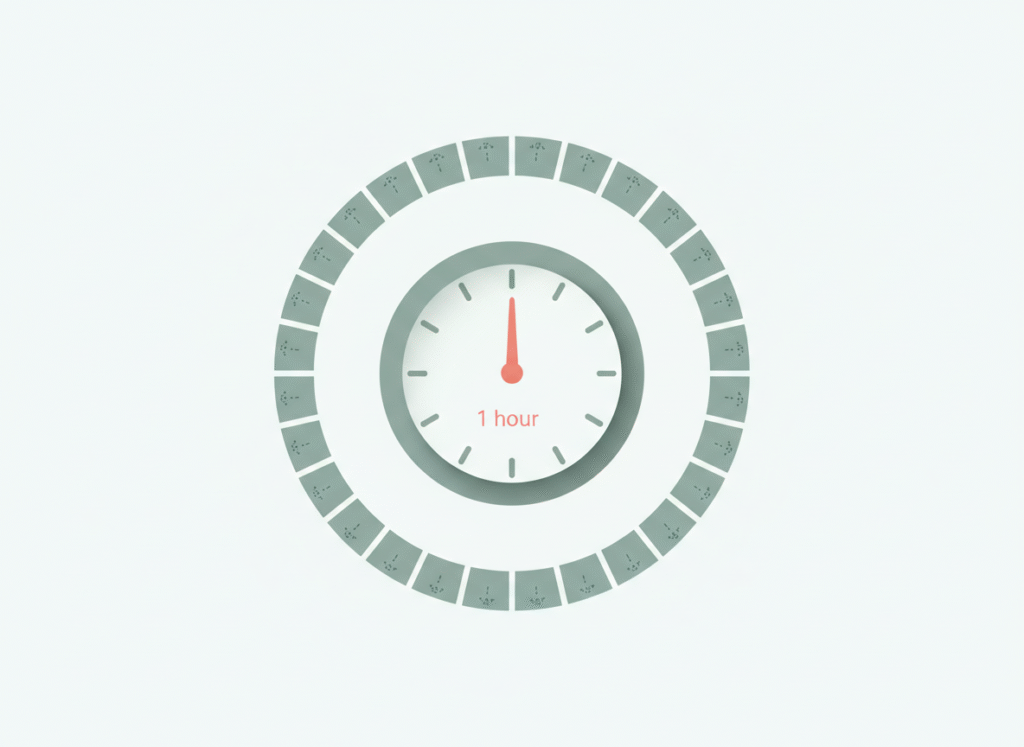
You leave the session with that feeling of "this is it," as if the world has finally been put in order.
And then life comes: rushed breakfasts, socks that mysteriously disappear, and a "I don't want to" that reminds you that this isn't about making it pretty, but about making it real.
An hour of therapy can ignite the spark, but learning is consolidated in the other 167 hours: in the pauses, in the glances, in the small "give me", "more" or "help" that are born when there is a reason.
When you understand this, you stop putting the weight of the week on a single session and start building progress in the only place where language really matters: the day-to-day.
____________________________________
Why is it okay in therapy sessions... but not at home (and why it's nobody's fault)
____________________________________
There is one word that completely changes the way we understand what is happening: generalization. To generalize is to carry a skill from one place to another, From one person to another, from an "ideal" moment to a real one. And yes: it's one of the most difficult parts of learning, especially for children with communication difficulties, because the brain doesn't always make that "transfer" on its own. Sometimes what is the same for us ("asking for water") is a completely different world for their brain: asking for water in a quiet room, with a prepared adult, is nothing like asking for water when there is hunger, noise, a rush, and a sibling singing at the top of their lungs.
In a session, there's structure. There are fewer stimuli. The materials are carefully chosen. The timing is carefully planned. Everything is designed to make the skill emerge more easily: the environment is supportive, the pace is helpful, the demands are adjusted. At home, on the other hand, life doesn't adjust: there's a rush, screens, fatigue, food, unexpected events. And, above all, there's emotion. And emotion—though it may not seem like it— consumes brain resourcesWhen your child is frustrated, tired, or overstimulated, it's not that they "don't want" to communicate; it's that their system is busy surviving. That's why the language stimulation at home It cannot be based on "let's see if he does it today", but on creating repeatable conditions so that the skill has a chance to emerge.
Furthermore, the approach to help changes. The therapist knows when to wait, when to model, when to reinforce, when to lower expectations, and when to maintain silence without intervening too soon. At home, with everything going on, it's very human to go to extremes: You help too much (because you don't want them to suffer, because you're in a hurry, because you can't bear another cry) or You're asking for too much. (because "he already knows," because you saw him do it and you cling to that image as proof that he can). And at both ends, unintentionally, we steal the bridge: either he doesn't have space to try, or the demand is so high that he disconnects.
That's why when your child doesn't do it with you, it's not that they can't. It's that their brain needs it. repeat the skill in more than one scenario to make it their own: with another person, in another place, with another object, at another time of day. Generalizing is not automatic. It takes training. And you train with something much more realistic than "doing it perfectly": you train with small repetitions, with well-placed pauses, with simple models and with the same idea over and over again... until one day, almost without warning, what previously only happened in training begins to appear in life.
____________________________________
What is “language stimulation at home” (without living in therapy mode)
____________________________________
When we talk about language stimulation in home, We're not talking about doing worksheets all day. Or repeating exercises as if your living room were a doctor's office. Or correcting every behavior as if you were carrying around an invisible notebook with "mistakes" and "successes" (because you already have enough on your plate just finding the other shoe). In fact, when the house becomes "permanent therapy mode," what usually happens is the exact opposite of what we're aiming for: you get exhausted, your child resists, and communication becomes an obligation instead of a tool for living.
We're talking about something much simpler, and at the same time, much more powerful: create micro-moments where your child has a real reason to communicate and one clear guide To achieve this. Because language doesn't appear simply by repeating words; it appears when there is intention, when there is a reason, when there is a "why." And that "why" isn't manufactured with cards: it's found in daily life. In wanting more, in needing help, in asking you to repeat yourself, in protesting, in sharing something that amuses them, in seeking you out for solutions.
That's why I like to think of it as "micro-therapy" (or, if you prefer a gentler term, "micro-opportunities"): moments of 30 seconds to 5 minutes, integrated into what already exists. At breakfast, when you hold the yogurt for a second before giving it to them and wait for a look. In the bath, when the sponge "makes a mistake" and you pause so they can ask for "another one" or point to you. During floor play, when you put a piece in a closed box and wait for them to ask for help. When getting dressed, when the sock becomes an excuse to look, wait, imitate, and participate. At the park, when you stop for a second before pushing the swing and give them the opportunity to ask for "more." When putting away toys, when you turn "putting away" into a shared turn instead of a battle. When packing their backpack, when each item is an opportunity to point, anticipate, choose, and communicate.
And here's the key: It's not about adding more things to your day. It's about looking at your day with different eyes. About understanding that language stimulation at home isn't about "doing more," but do the same, but with intentionA pause, a turn, a simple model, a gentle repetition. Because when you do it this way, language stops being an exercise and becomes what it was always meant to be: a way to connect with you in the midst of real life.
____________________________________
A system that actually holds up (and won't break you)
Most families don't quit because they "don't care." They quit because they're exhausted. Because they feel it's never enough. Because they try to do it all: be a mom or dad, run the household, work, manage appointments, and on top of that, "do preventative care" as if they were a complete therapy team. And there comes a point when the head says "I can't take it anymore," even though the heart says "of course I want to." That's why, when we talk about language stimulation at home, We can't just talk about techniques: we have to talk about sustainability. Something that works on normal Mondays... and also on those Tuesdays when your day goes off the rails before 9:00.
If you want to sustain it, you need a system that takes care of you too. Because if the plan depends on you having energy, time, and infinite patience, it's not a plan: it's a fantasy. A realistic system is one that holds up even when you're tired, even when you're in a rush, even when your child is having a tough day. And that's built on a very unglamorous but very powerful idea: Less, but better.
Start with this: Fewer targets, better chosen. The most common (and most human) mistake is trying to work on everything at once: attention, language, behavior, independence, play, tolerance… and, while we're at it, get them to sleep better and eat broccoli. The result: you get exhausted and your child receives confusing messages. On the other hand, when you choose 1–2 goals per week, You give the brain a clear direction. For example: shared perspective (to look and look at you again), imitation of an action, ask for “more” with gesture or word, follow a simple instruction. Not because the rest doesn't matter, but because progress needs focus to consolidate.
Then, choose repeatable routines. Repetition isn't boring: it's security. For many children, repetition is the "solid ground" that allows them to anticipate and participate. When a pattern is repeated, the brain stops wasting energy guessing what's next and can dedicate it to learning. Two or three fixed routines can change everything. bubble–pause–look–more; short song with a pause so that it completes; surprise box (open–wait–order). And here's the beauty of it: you don't need to invent twenty activities; you need two or three that become familiar, almost automatic, like your morning coffee (but with less dependence, or so we try).
And here comes the golden rule that transforms the most: pause before helping. Communication arises when there is space. At home, out of love and for survival, we tend to help too quickly: we open doors, give gifts, solve problems, translate. And it's understandable, because nobody wants a drama over a cookie. But that pause... 3–5 seconds It is the bridge between need and communication. Present the object or activity. Pause. Look at their face (not the object). If no intention appears, model (gesture/word) and help. That simple sequence teaches him something enormous: "if I try to communicate, things happen." And that's worth more than repeating a word ten times.
And something that almost no one says out loud, but that makes all the difference: One regulated adult is worth two techniques. If you're at your limit, everything becomes an uphill battle. Supporting someone isn't about pushing yourself too hard. It's about lowering expectations on difficult days, returning to simplicity, and prioritizing connection and motivation. Because the goal isn't for your home to look like a perfect photoshoot. The goal is for your child to have real opportunities to communicate… and for you to be able to support them without breaking down in the process.
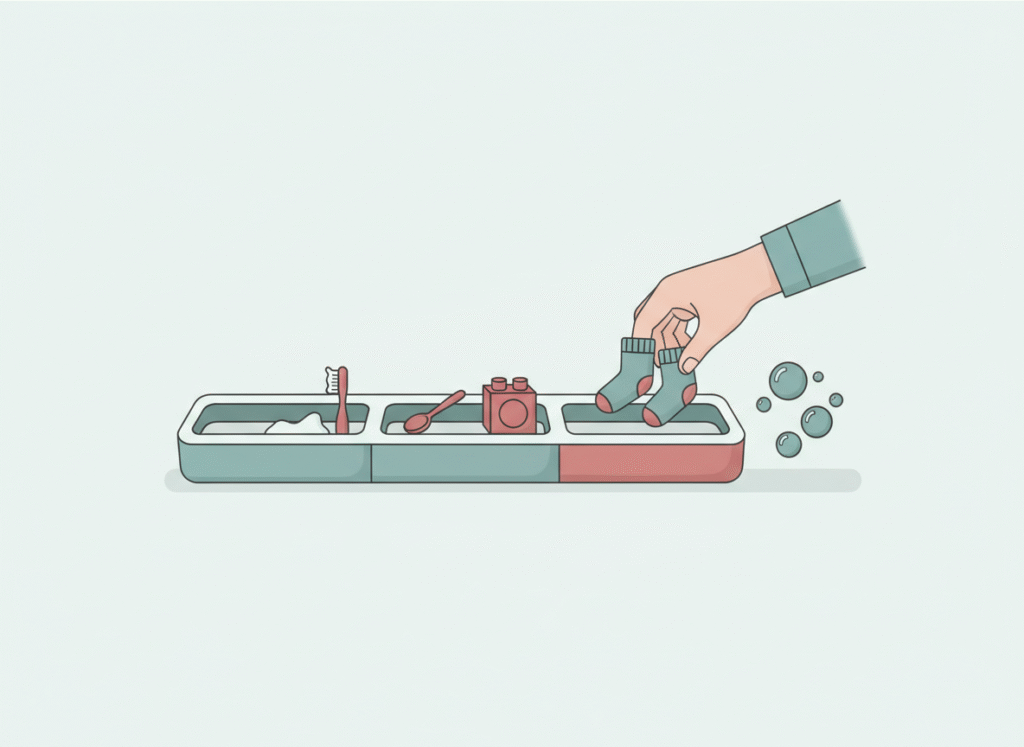
Routines are that good "autopilot": the one that saves you when you don't have the energy to invent a therapy at 8:12 in the morning.
When the order is repeated (getting dressed, bathing, putting away toys), the brain stops wasting resources guessing what's next and can dedicate them to what's important: communicating, imitating, waiting, asking, and connecting.
It is not rigidity: it is security; and security is the ground from which gestures, glances and, little by little, words emerge.
Because what endures is not perfection: it's simplicity, repeatability, and what fits into your life... even on those days when your sock wins the battle again.
____________________________________
A realistic 7-day plan to get started (without putting too much pressure on yourself)
____________________________________
If you're thinking today, "Okay, but... where do I start?", start small. Start with something possible. Because when you're tired, what gets you down isn't a lack of love: it's the feeling that you need to do everything perfectly, every day, and with a smile. And that's not a plan; it's a recipe for giving up. A realistic plan is one that fits into your life as it is: with rushing, unexpected events, and days when your energy is at 30%. That's why we're not going to try to "do a lot" here; we're going to try to do the same thing repeatedly.
During days 1 and 2, choose a goal and a routine. Just one. Not because the rest don't matter, but because the brain learns best when it has a clear direction. For example: objective “asking for more” (with gesture, look, sound or word); routine bubbles either song with pause. And here's the detail that makes all the difference: it also decides when You're going to do it (after your bath, before dinner, when you get home from school). Don't put it off "when I can," because "when I can" usually means never. Two minutes of intention are worth more than twenty minutes of improvisation.
On days 3 and 4, repeat the routine once a day. Just one. Three to five minutes. Same place, same order. Don't strive for perfection: strive for repetition. Repetition is what tells the brain, "This is important." And it also takes the mental burden off you of inventing. If one day goes just okay, don't make a big deal out of it: think, "Perfect, today we trained under realistic conditions." Because the language stimulation at home It is not measured by how beautiful it looks, but by how durable it becomes.
On days 5 and 6, add a second context. If you did it with bubbles, try it with food or the swing. The skill is the same; the scenario changes. And that change is invaluable, because that's where the training takes place. generalizationThe goal is for your child to learn not "bubbles," but "I can ask for more." Something curious (and very human) often happens here: the adult is surprised because "they did it yesterday" but not today. And that's precisely where we need to remember that we're not looking for a trick, we're building a skill.
And on the 7th, register three signs of progress. Don't look for "words." Look for intentionThey look at you more, wait, come closer, bring you something, mimic an action. These signs are the foundation. They are the "before" of words. And when you learn to see them, your approach to support changes: you go from chasing results to sustaining processes.
____________________________________
Signs that you're holding it correctly (even if it doesn't seem like it)
____________________________________
Sometimes progress doesn't look the way you expect. It doesn't appear as a perfect sentence. It appears as something smaller and more real. It's seen in more moments of shared calm. In your child seeking you out more for help. In the appearance of gestures, sounds either glances With intention. It means sitting down with a plan, not improvising all the time. And it's also reflected in something very important: you begin to trust the path, even when the day is going badly.
And, above all, it's reflected in something worth its weight in gold: in the fact that daily life ceases to be an exam and begins to be a journey. Because when the language stimulation at home It becomes sustainable, it stops feeling like "just another obligation" and starts to feel like what it really is: a way of being, of looking, of waiting and of connecting.
If this article helped you, Share it with another mom or dad who feels alone in the process. Sometimes, the first step isn't "doing more," but feeling that you can sustain it. And if you saw yourself reflected in this while reading, if you're at that point of "I want to do it right but I don't know where to start,", You can write to me from the page of contact and we'll look at it together calmly.
Cristina Oroz Bajo
Founder of VICON Method, President of the Association for Aid to Children with Disabilities (AAND) and CEO of I Read Too.
Democratizing educational methodologies inclusive.