Down syndrome doesn't need pretty words or condescending looks. It needs something more useful: real support, guaranteed rights and everyday inclusion for the child, for his parents, and also for his siblings.
Inclusion isn't demonstrated with a post. It's demonstrated with accessibility, resources, and a supportive community.
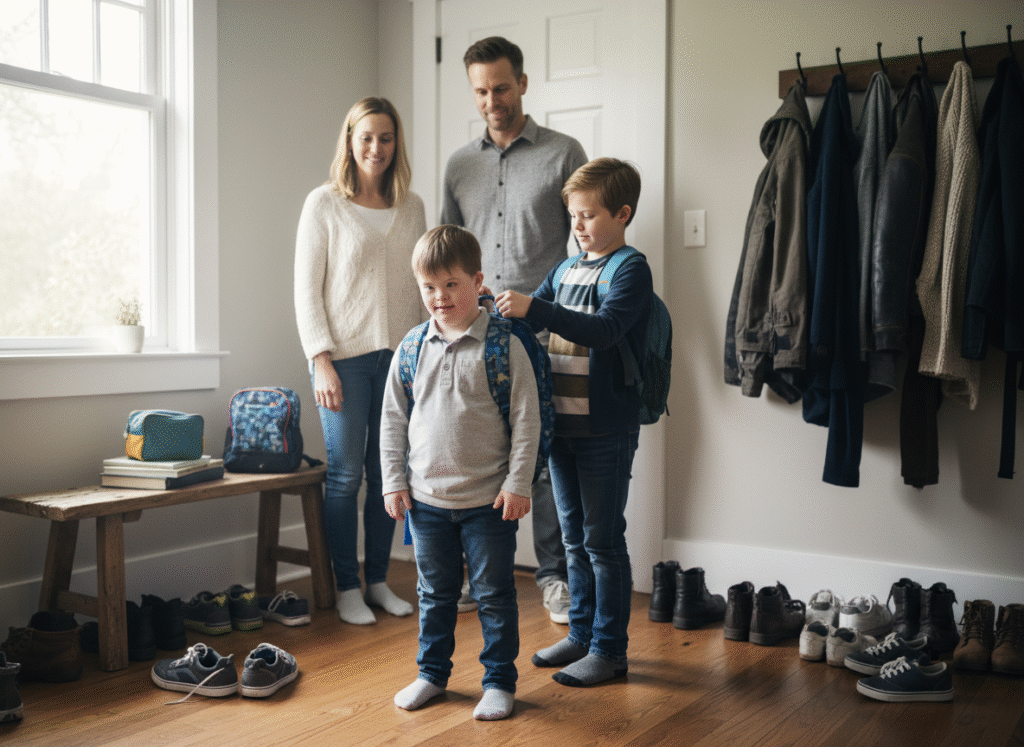
Every March 21st, the Down syndrome It appears on social media with messages of love, tender photos, and slogans that aim to raise awareness. And yes: visibility matters. But there's a part that almost never makes it into the carousel: the next day. March 22nd. When you still have to get up, pack backpacks, coordinate schedules, maintain routines, take them to therapies, answer messages from school, and explain—again and again—what your child needs.
This article is for families and for society. To look at things head-on, without dramatizing or sugarcoating. To understand what happens in real life (at home, at school, on the street) and what concrete actions make a difference.
1) Down syndrome is not an inspirational story: it is real life
Speaking fondly isn't romanticizing. But romanticizing is telling an incomplete story.
This happens when we turn Down syndrome into a character: “They are pure love”, “always happy”, “little angels”. Those phrases sound nice, but they leave out the human element. They leave out the exhaustion, the doubts, the uncertainty, and the difficult decisions these families face. And they also leave out something crucial: that this child will grow up. He will be a teenager. He will be an adult. And he deserves to be treated with dignity, not as an infantilizer.
In real life, a family can be deeply proud and, at the same time, exhausted. They can celebrate achievements and, at the same time, worry about the future. They can love wholeheartedly and, at the same time, need rest. That's not a contradiction: it's life in its entirety, it's real life.
When only the sentimental narrative dominates, something serious happens: society stops understanding why a family needs support, adaptations, resources, and respect. And when it's not understood, it's judged.
2) Real family life is not sustained by admiration: it is sustained by a safety net
In many homes, daily life is organized around things that go unseen. Not because the family wants to "do extra," but because the system demands it: medical appointments, stimulation, school, transportation, reports, calls, paperwork, authorizations.
Meanwhile, normal life goes on: work, shopping, dinners, siblings with chores, accumulated fatigue. There are days when everything goes smoothly and days when the slightest change throws everything into disarray.
Many families become much stronger (because they have no other choice). They learn to negotiate with institutions, to have difficult conversations, to defend their rights without losing their composure. But a strong family doesn't mean it doesn't need support. It means it's doing an enormous amount of work.
A united family can support a great deal. But no family should have to support it all alone.
3) Siblings also experience Down syndrome (and also need care)
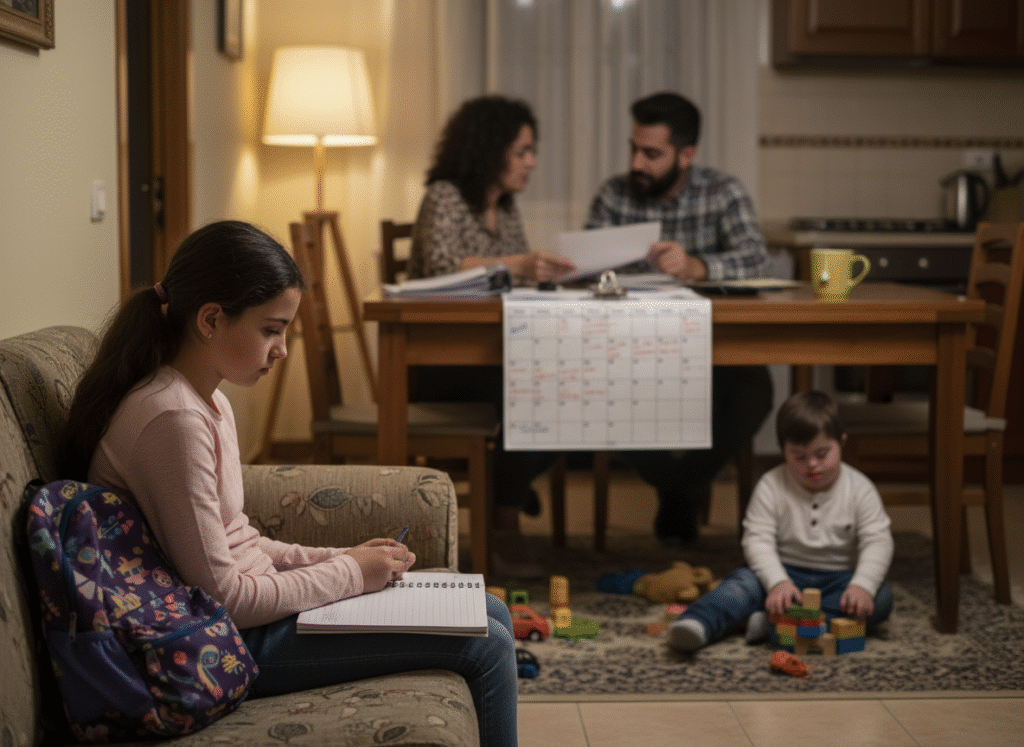
When we talk about Down syndrome, we almost always focus on the child. But there's more to the family: there are siblings who wait, who adapt, who give up their time, who listen to adult conversations, who encourage their sibling, who try to include them wherever they go, who learn to be "strong" too soon.
Some siblings become experts at "not bothering anyone." They bottle up their sadness so as not to add to the burden. They feel immense pride and love... and also jealousy, guilt for feeling jealous, fear, or the feeling that "there's no room" for their feelings. And all of that is normal.
Sometimes, the older sibling becomes the "second adult" without anyone asking for it. Sometimes, the younger sibling grows up with the idea that they have to be perfect to compensate. Sometimes, what they need most is simple: undivided attention, a leisurely conversation, a plan just for them.
Supporting a family also means asking about the siblings: how they are, what they need, what personal space they have, and who they can talk to. Because family well-being is built when everyone grows up with their needs met.
4) Inclusion is not about “being there”: it is about participating with support
Inclusion isn't just about a child being in a classroom, at a birthday party, or participating in an activity. Inclusion means they can participate.
Participation means that the environment adapts: timing, support within the classroom, Accessible materials, clear communication, high expectations with Support (not empty demands). It means that he is not paraded around to "set an example." That he is not applauded as if he were a pet. That he is respected as a colleague.
Inclusion collapses when everything depends on the mother "making do," the teacher "doing their best," or the child "adapting." Inclusion thrives when there is a system in place: resources, training, coordination, and a school culture that understands that adapting is not "doing favors," but rather guaranteeing rights.
5) The family needs to get stronger (yes), but it also needs the world to loosen up.
There is something valuable in the message that “the family unites and raises the child”: it speaks of love, teamwork, and resilience. But be careful not to turn that into a mandate.
Because if the discourse remains at "the family can do it," the system washes its hands of the matter. And no: Down syndrome is also a matter of rights, policies, and resources.
Strengthening the family is not about demanding more from it. It's about giving it what it needs. tools, It's about rest, guidance, and a safety net. It's about allowing things to not depend entirely on one person. It's about having a break without guilt. It's about having emotional support to sustain things in the long run.
And yes: a united family makes a difference. When adults are on the same page, when they share responsibilities, when they allow themselves to ask for help, when they nurture the relationship between partners (if there is one) and the bond with siblings, the child feels it. But this unity doesn't come from pressure: it comes from support.
6) What helps most is not pity: it's respect + concrete actions
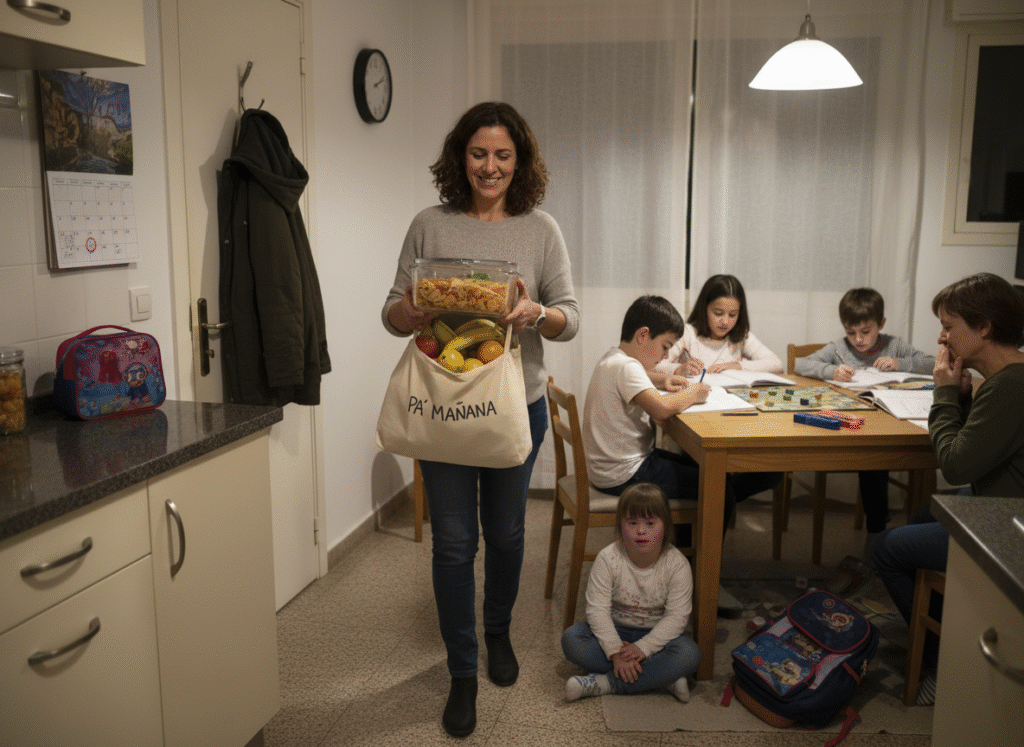
If you want to support a family, don't start by giving your opinion. Start by asking respectful questions.
Because many families are already tired of hearing: “I would…”, “In my day…”, “But if he tries…”. What they need isn't just a random piece of advice. They need someone who's there for them.
If you wish to accompany them:
- Believe what they tell you: If they tell you "this is difficult for him," don't argue with them. If they tell you "this is exhausting for him," don't downplay it.
- Offers specific help (with format and schedule): “"Should I stop by on Thursday and stay with the brothers for an hour?" "Should I accompany you to a shift?" "Should I bring you a meal ready for tomorrow?"”
- Speak to the child according to their age: Don't treat him like an infant. Don't talk to him as if he's not there.
- Respect the rhythm: Don't rush him, don't complete things for him, don't expose him to "show that he can.".
- Defend in everyday life: If someone makes a joke, if someone gives a strange look, if someone excludes you, don't stay silent.
Sometimes, the greatest help is the smallest: someone covering for you for an hour so you can take a nap. Someone accompanying you to a difficult school meeting. Someone asking about your other child. Someone saying "I'll take care of it" without making you feel indebted.
7) World Down Syndrome Day should translate into real rights and inclusion
This March 21st, in addition to sharing a photo, ask yourself: what really changes for these families on March 22nd?
It changes when there is:
- Accessible and coordinated health monitoring
- Early intervention and continuous support without violent bureaucracy
- Inclusive school with resources (not just “goodwill”)
- Real opportunities for autonomy, leisure, participation and, later on, employment
- Emotional support and respite for mothers, fathers and siblings
Because the Down syndrome It doesn't need to be an "inspiration" for others. It needs to be a dignified life for the person who lives it.
If you truly want to celebrate Down syndrome, celebrate with action: accessibility, respect, resources, and community.
Cristina Oroz Bajo
Founder of VICON Method, President of the Association for Aid to Children with Disabilities (AAND) and CEO of I Read Too.
Democratizing educational methodologies inclusive.