«No le pidas que te mire. Dale algo que valga la pena mirar contigo.»
Cristina Oroz Bajo
It's not magic: it's learning to see things together. And when that happens, everything else starts to flow.
Joint attention is the bridge between two worlds. When your child sees what you see, they begin to understand that you exist. And that changes everything.
The joint attention es uno de esos conceptos que suena complicado pero que en realidad es muy simple: es cuando tu hijo y tú miráis lo mismo, al mismo tiempo, sabiendo que el otro también lo está mirando. Parece fácil, ¿verdad? Pero en autismo, esa capacidad suele no aparecer de forma natural. Y sin embargo, es el cimiento de todo: del lenguaje, de la interacción, de la comprensión. En este artículo vas a descubrir qué es exactamente la joint attention, Why it's so important, and how to work on it at home with practical examples that fit into your daily life.
Y quiero decirte algo claro desde el principio: la atención conjunta no se consigue exigiendo «mírame». Obligar a un niño a mirar a los ojos no crea conexión: crea presión. Lo que funciona es justo lo contrario: entrar tú en su mundo.
Before we begin: what is (and what is not) joint attention?
Imagine you're in the kitchen with your child. You point to the window: "Look, a bird." At that moment, your child looks at the bird, you look at the bird, and you both know the other is looking too. That's joint attention. It's not just looking. It's looking together, knowing the other is there as well.
In autism, many children look, but they don't "look with you." They see the object, but they don't establish that connection of "we both see the same thing." Sometimes they avoid eye contact. Sometimes they look at the object but not at the face of the person pointing. Sometimes they simply don't understand that when someone points, there's something important to look at.
Joint attention is not obedience. It's connection.
Why joint attention is so important (and it's not just "looking")
Joint attention is the bridge between you and your child. And without that bridge, many things can't happen.
When your child learns to look at what you point to, they are learning that the world has shared meaning. That when you say "look," there is something important. That your intention matters. That there is a connection between what you see and what they can see as well.
That opens the door to language. Because language isn't just words: it's sharing meaning. When your child says "ball," it's not just a word: it's saying, "I see what you see, and I want you to know that I see it." Without joint attention, words float aimlessly.
Joint attention is also the foundation of social interaction. When two people are looking at the same thing, they can play together, they can learn together, they can truly be together. Without it, each is in their own world.
Signs that joint attention is (or is not) present
Before starting to work on it, it's helpful to know where your child is now. Some signs that joint attention is not yet present:
Your child doesn't follow your finger when you point. You see a bird, you point, but he keeps looking at what he was looking at before. Or he looks at your finger, but not at what your finger is pointing at.
Your child doesn't look at you to "share" something. He doesn't look at you when something catches his attention, as if he wants to say, "Do you see what I see?".
Your child avoids eye contact when you speak. Or they maintain eye contact, but without that feeling of "being there with you.".
Your child doesn't understand gestures. When someone points, he doesn't grasp the intention. When someone nods, he doesn't interpret it as meaning "yes.".
If you recognize several of these signs, joint attention is an important goal. And the good news is that it can be worked on. Every day. In simple moments.
El «mírame» que no funciona
Muchas veces la atención conjunta se trabaja sentados a la mesa, pidiendo «mírame» y reforzando cada mirada. Luego se le pide a la familia que «lo repita en casa». Pero la atención conjunta no aparece a demanda: nace cuando un niño descubre que mirar contigo merece la pena.
Y eso ocurre en el baño, en el parque, en la cocina, no una hora a la semana. Por eso las estrategias que vienen a continuación están pensadas para tu día a día, y funcionan mucho mejor cuando todos los adultos que le rodean las usan igual.
How to work on joint attention at home: 7 strategies that work
1) Start with what they already love
Don't start with something that doesn't interest him. Start with what already has him mesmerized: a toy, a sound, a movement, a texture. When your child is absorbed in something he loves, that's the perfect moment.
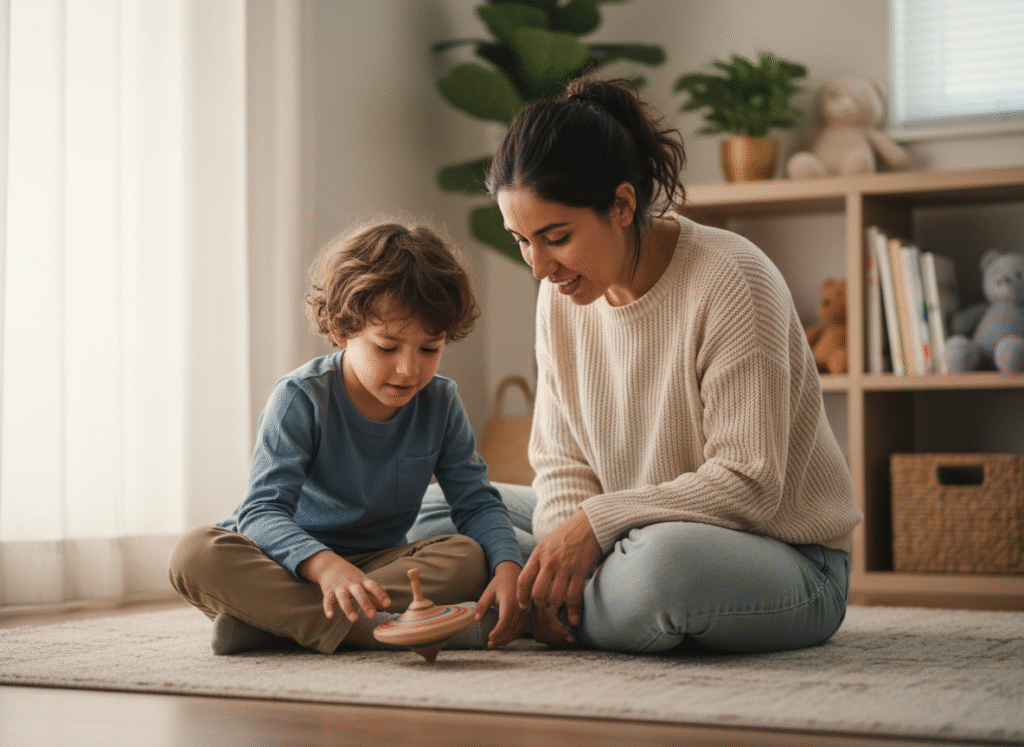
Approach them, get down to their level, and enter their world. If they love spinning a wheel, spin it with them. Wait for them to look at you. And when they do, celebrate. It's not a "whim": it's the first step in joint attention.
2) Point with your finger, but also with your face
When you point at something, don't just extend your finger. Look at the object, then look at your child, then look back at the object. Your face is a signal. Your gaze is an invitation. "See what I'm looking at.".
Sometimes it helps to accompany the gesture with a simple word: "Look." Or a sound: "Ooh!" Something that says, "This is important.".
3) Create moments of "shared surprise"«
Unpredictable moments are powerful. When something unexpected happens, the child looks up. And if you're surprised too, there's a moment of connection.
It can be something simple: suddenly dropping a toy, making a strange noise, someone appearing in the doorway. In that moment of surprise, look at your child. Wait for them to look at you. That's joint attention.
4) Play with turns and anticipation
Turn-taking games are pure gold for joint attention. "I do something, you do something, I do something." Hide-and-seek, throwing a ball, tickling.
When it's your child's turn, wait for them to look at you before continuing. It's not to "punish" them; it's to create that moment of connection. "I'm waiting for your signal. I'm waiting for you to look at me.".
5) Use small, eye-catching objects
Sometimes a large object doesn't work. But a small, shiny object that makes noise and moves unexpectedly—that works. Place the object between you and your child, at eye level. Move it slowly. When your child follows it with their eyes, move it toward your face. Wait for them to look at you.
6) Name what you see together
When you achieve that moment of shared attention (both of you looking at the same thing), name what you see. It's not a lesson. It's simply: "Look, a bird." "Look, water." "Look, red.".
That links joint care with the language. Tu hijo empieza a entender que cuando miráis juntos, las cosas tienen nombre.
7) Celebrate every attempt, not just the "successes"«
If your child looks at you for a second, celebrate. If they follow your finger, even to the wrong thing, celebrate. If they come to you when something catches their attention, celebrate.
Joint attention doesn't appear all at once. It appears in micro-moments. And every micro-moment counts.
Real-life examples: what joint attention looks like in everyday life
You're in the park. Your child is on the sand. Suddenly, a butterfly flies by. You see it, point to it, look at it, then look back at your child. Your child looks up, looks at you, then looks at the butterfly. That's a moment of joint attention.
Or at home, during a meal. Your child is eating. You make a funny sound with your mouth. Your child looks at you, smiles. You make the sound again. That's another moment.
Or when you bathe your child. You pour water into a cup, you tip it over. Your child watches you, expectant. You do it again. That's joint attention: he's waiting for you to do something, and you both know the other is in on it.
Patience: joint attention is not a race
Sometimes you work for weeks and see no change. Then, suddenly, your child looks at you when you point something out. And it's like the world lights up.
Joint attention is one of those goals that requires patience. But it's also one of the most transformative. Because when your child starts to see what you see, they begin to understand that there is a "we." And that's the foundation of everything else.
Mirar juntos, primero
Antes de pedirle que hable, enséñale a mirar contigo. La primera palabra nace de una mirada compartida.
Elige un juego que le encante y dedícale diez minutos al día, solo con dos estrategias: entrar en su mundo (la 1) y crear sorpresas compartidas (la 3). Apunta cada vez que te mire para enseñarte algo. Pide a quien más tiempo pase con él que haga lo mismo.
Si este artículo te ha servido, pásaselo a otra familia: cuando los niños aprenden a mirar juntos, todos aprendemos a estar juntos. Y si quieres un plan con canciones y vídeo modelado para trabajarlo, pide la valoración inicial de Método VICON (semana de prueba incluida).
Cristina Oroz Bajo
Founder of VICON Method, President of the Association for Aid to Children with Disabilities (AAND) and CEO of I Read Too.
Democratizing educational methodologies inclusive.