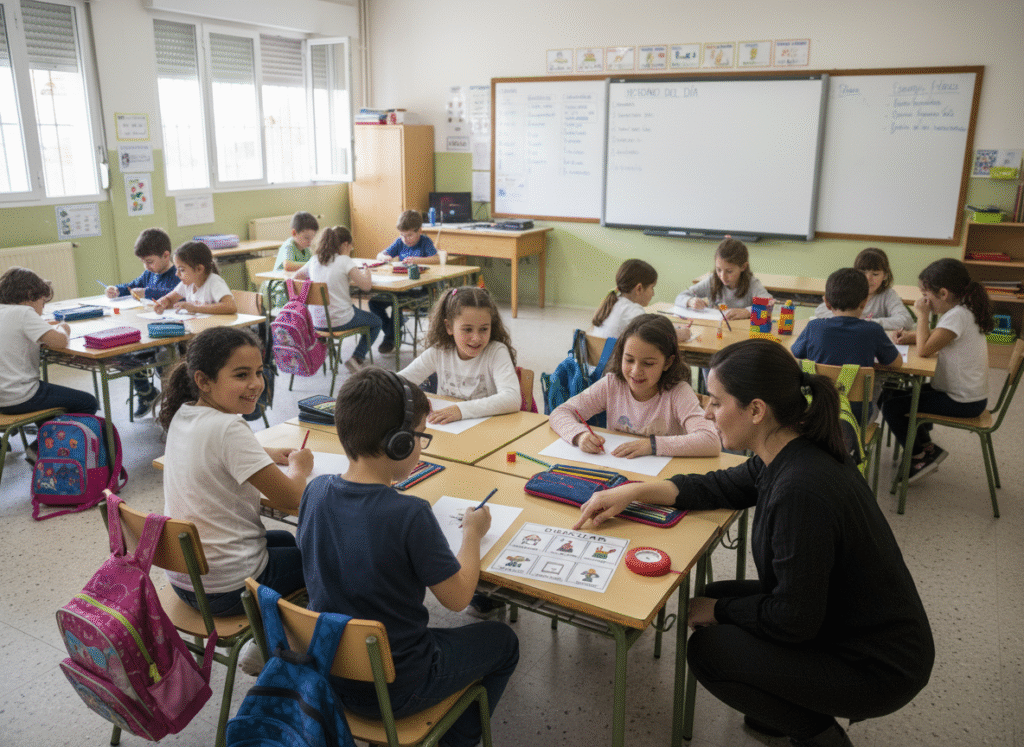
Inclusion isn't about a student "being" in class. It's about them being able to participate With real support, without being left behind in learning or connection. And that's not achieved through sheer willpower: it's achieved through small, repeated decisions that change the day.
Inclusion is not measured by enrollment. It is measured by student participation.
There's a scene that repeats itself more often than we'd like to admit. It's Monday, first period. Class begins, the teacher explains, the group responds… and there's a student sitting there, well-behaved, "not bothering anyone." No one would say there's a problem. But if you look a little closer, you see it: he doesn't ask questions, he doesn't choose, he doesn't engage, he doesn't participate. He's present, but he's not involved.
That's what I mean when I talk about real inclusion in the classroom. This is not just talk. It's a daily experience: either the student can participate, or the classroom becomes a place where they learn to disappear.
And if we talk about autism, This scene often has very specific nuances: the student who seems "in their own world," the one who covers their ears when the classroom volume rises, the one who understands but can't respond in time, the one who becomes disoriented just when the activity changes. It's not a lack of motivation. Often, it's a lack of accessibility.
In this article, I'll share simple (truly simple) support strategies that can change participation. Not as a list of "tips," but as a way of looking at things: what barriers are unintentionally created and how to dismantle them with concrete resources.
What does “participation” mean (and why simply being present is not enough)
Participating isn't just raising your hand. Participating is power. understand what is expected, to have a role, to be able to ask for help, to be able to make mistakes without shame, to be able to sustain care with support, be able to communicate (with or without words) and feel that the classroom is also your place.
In autism, participation can look different: sometimes the student participates by looking for a second and then looking again; sometimes they respond by pointing; sometimes they need more time; sometimes their “yes” is to approach, and their “no” is to move away. The question isn't whether they participate “like everyone else.” The question is whether the classroom provides them with a way to participate.
When a student doesn't participate, it's often interpreted by those around them as a lack of interest, a lack of boundaries, or that they're "not ready." But in practice, what's usually lacking isn't ability: it's accessibility.
And accessibility isn't about lowering standards. It's about opening the door.
The invisible barrier: slogans that are said once and then evaporate
Imagine this scenario: the teacher explains an activity aloud, while handing out materials, answers a question, and asks for silence. For many students, that's enough. For others, that instruction vanishes like smoke.
In autism, this is very common: the verbal instruction arrives mixed with noise, movement, glances, and social expectations. And the student, who could do it, freezes. Or leaves. Or “misbehaves.”.
Simple support here isn't about "repeating louder." It's make the slogan visible.
When the instructions are visible, the student stops relying on auditory memory and the stress of the moment. They can look again. They can orient themselves. They can begin.
In the real inclusion In the classroom, this changes everything: the student goes from waiting for someone to rescue him, to being able to start on his own.
Support 1: Anticipation that calms (not to control, but to provide security)
Some students don't become dysregulated by the assignment itself. They become dysregulated by the uncertainty. Not knowing how much longer it will take, what comes next, when it will end, or who will help them.
In autism, uncertainty is often felt physically: rigidity, avoidance, crying, anger, running away. And often the trigger is not "the class," but the change: going from reading to physical education, going to the cafeteria, coming back from recess.
Anticipation isn't a perfect schedule. It's a gesture of respect: "I'm showing you the map so you don't walk blindly.".
A whiteboard with three times of day, a phrase before each change, a "when we finish this, we're going to..." said in advance. This reduces misbehavior, but above all, it increases participation: the student stops wasting energy guessing and uses it to learn.
Support 2: A real role (because belonging also means having a function)
In many classrooms, the student who struggles is left as a spectator. And the spectator quickly learns that he's not expected to do so.
At autism, This can happen even when the student "doesn't cause any trouble": they're left out, without turns, without tasks that connect them to the group. And then we're surprised that there's no connection.
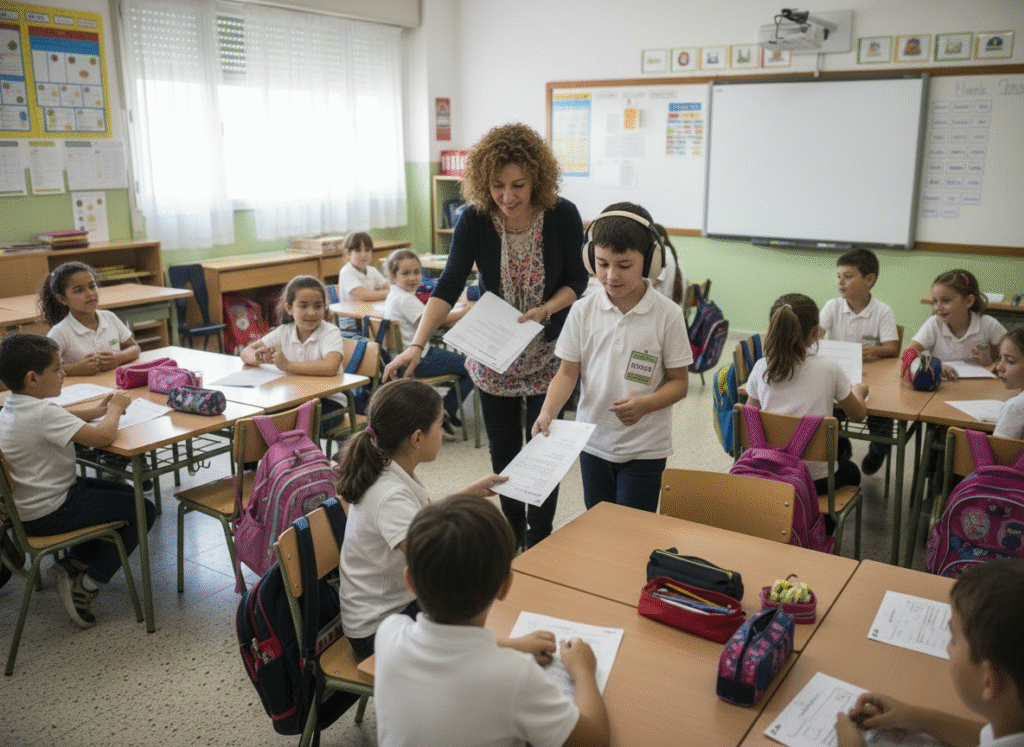
A simple way to support them is to give them a real, not symbolic, role. Not just "pass me the eraser" to keep them busy, but a function that connects them with the group: handing out papers, being in charge of starting the session, choosing the order of participation, holding materials.
Sometimes the role is also social, but with a specific form: "you choose who starts," "you carry the 'turn' card," "you demonstrate with the teacher." When a student has a role, the classroom sees them differently. And they see themselves differently too.
Support 3: Accessible communication (talking is not the only way to participate)
Some students understand more than they can express. Others freeze up when they have to speak in front of everyone. And some need visual aids or alternative communication systems.
In autism, this is key: many students have language, but they don't always have access to language in a social context (eye contact, turn-taking, speed, pressure). Others need augmentative or alternative communication to participate without frustration.
True inclusion in the classroom is evident when the teacher does not expect "the perfect form" of response, but rather enables pathways.
A student can participate by pointing, choosing from options, using a card, showing, marking on a sheet of paper, or responding with gestures. They can respond with a single word, an image, or a clear "yes/no." The question is not "Does he/she speak or not?" The question is "Does he/she have a way to say something?".
When communication becomes accessible, the behavior decreases because the student no longer needs to explode to be heard.
Support 4: Adjust the start (because starting is the hardest part)
Many students don't fail at the task itself: they fail at the beginning. They don't know where to start, they get overwhelmed, they freeze, they give up.
In autism, the beginning can be difficult for several reasons: the sheet full of information, the open-ended instructions, the fear of making a mistake, or simply not knowing what to expect first.
A simple support is to adjust the start: show the first step, leave it ready, start together for 30 seconds, and then let go.
For example: instead of “do the activity,” start with “first we write the name,” or “first we circle it,” or “first you choose between these two options.” This micro-guidance is like pushing a heavy door: you don’t walk the path for the student, you just open the door for them.
Support 5: Planned breaks (so that the body can also be present in class)
Sometimes students "misbehave" when they are actually overwhelmed. Noise, lights, movement, social demands.
In autism, sensory and social overload can build up silently… until it explodes. And when it explodes, the classroom perceives it as “a behavioral problem,” when often it’s a problem of regulation.
True inclusion in the classroom includes the body. A short, agreed-upon break, with a clear place and a clear return, is neither a reward nor a punishment. It is regulation.
A simple example: a "pause" card, a quiet corner, headphones for specific moments, or a purposeful movement task ("take this to the office and come back"). When students know they can take a break without losing their place, they participate more. Because they're not struggling to survive the environment.
Support 6: Assessment adjustments (without lowering expectations)
Evaluation is not about measuring who adapts best to the format. Evaluation is about seeing what they learned.
In autism, the format can be a barrier: open-ended questions, short time limits, extensive reading, writing as the only channel. And in these cases, the student "performs less" not because of the content, but because of the format.
A student can demonstrate understanding in other ways: orally instead of in writing, with options instead of open-ended responses, with visual support, with more time, with fewer items.
This isn't "giving them an advantage." It's removing a barrier that has nothing to do with the content.
Support 7: A reference adult (and coordination that doesn't depend on miracles)
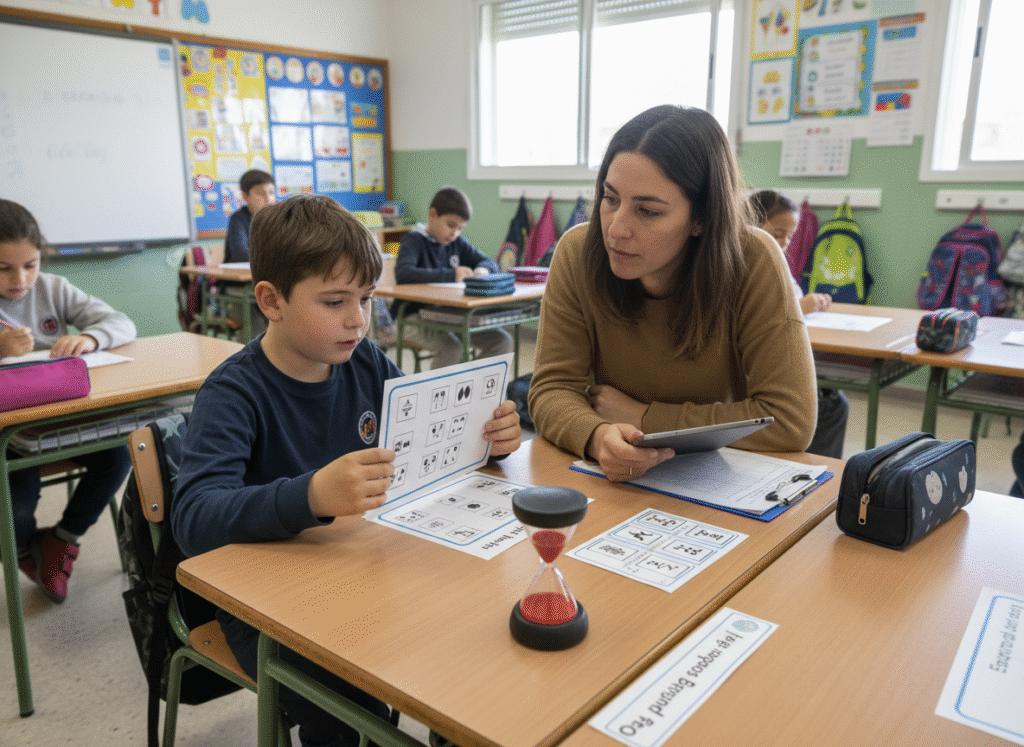
In practice, many students participate when there is an adult who understands their needs and coordinates support: tutor, special education teacher, speech therapist, integration specialist, counselor. But the problem arises when that support is improvised or isolated.
In autism, consistency among adults is a form of support in itself: the same words to anticipate, the same signals to ask for a pause, the same agreements for transitions. When everyone does things "their own way," the student experiences the day as unstable ground.
True inclusion in the classroom requires coordination: simple agreements, common language, and clear objectives. Not just to fill out paperwork, but so that students don't have to "start from scratch" with each teacher.
What changes when inclusion is real
When these supports appear, something exciting happens because it is profoundly human: the student begins to be involved.
In autism, this is seen in small details: he gets a little closer to the group, tolerates change with less tension, asks for a pause before exploding, responds with an image when speaking is difficult, accepts a turn because he understands the order.
He starts looking when his name is called because he knows what's coming. He starts choosing because he has the means to do so. He starts trying because mistakes don't expose him. He starts belonging because the classroom awaits him.
And the group learns something else too: that diversity is not just talk. It's a practice.
True inclusion in the classroom isn't about "integrating" someone. It's about designing a classroom where more students can participate.
Simplicity is not insignificant.
Sometimes people think that inclusion requires a revolution. And yes: it requires policies, resources, more staff, and training. But in everyday life, true inclusion in the classroom is also built with simple, sustained, and consistent support.
If you're a teacher, school administrator, or family member, share it. And choose one concrete action for this week: make a directive visible, anticipate a change, enable an alternative way to respond, or plan a break.
Because when participation changes, school history changes.
Cristina Oroz Bajo
Founder of VICON Method, President of the Association for Aid to Children with Disabilities (AAND) and CEO of I Read Too.
Democratizing educational methodologies inclusive.